
There are four options to give:
- General Purpose Donation – Any amount donated for General purposes (i.e., for needs/purposes other than those earmarked below) will go towards operational expenses, e.g., purchase of food supplies and paper products for the after-Mass fellowship, payment for marketing needs and janitorial services, etc.
- “Make Your Spirits Bright” Decorations Fundraising – You may choose to make a donation for the Christmas decorations displayed outside the church. Pictures of these are available on the parish website and on posters around the church. Options include pre-lit Christmas Angels, lighted “Joy” letter signs, lighted lamppost, and peppermint LED lights lawn stakes. (Suggested donation amounts range from $30 to $240.)
- Mass Sponsorships – You can sponsor one or multiple Simbang Gabi Masses as a love offering. (Suggested minimum donation: $25.00/Mass.)
- Mass Intentions – Mass Intentions for your loved ones – living or deceased – may be offered for one or multiple Simbang Gabi Masses of your choice. (Suggested minimum donation: $10/name).
For general-purpose donations, Mass sponsorships, and decorations donations, the donor’s or sponsor's name will be acknowledged on the overhead screen before and during the Simbang Gabi Mass. For Mass intentions, the names offered will be shown on the overhead screen.
We must receive your form no later than 9:00 PM on the evening prior to the preferred Simbang Gabi date, to enable inclusion of your name or Mass lntention(s) in the Mass of the same date. If we receive your form past your preferred date and/or time, we will include it in the next Simbang Gabi Mass.
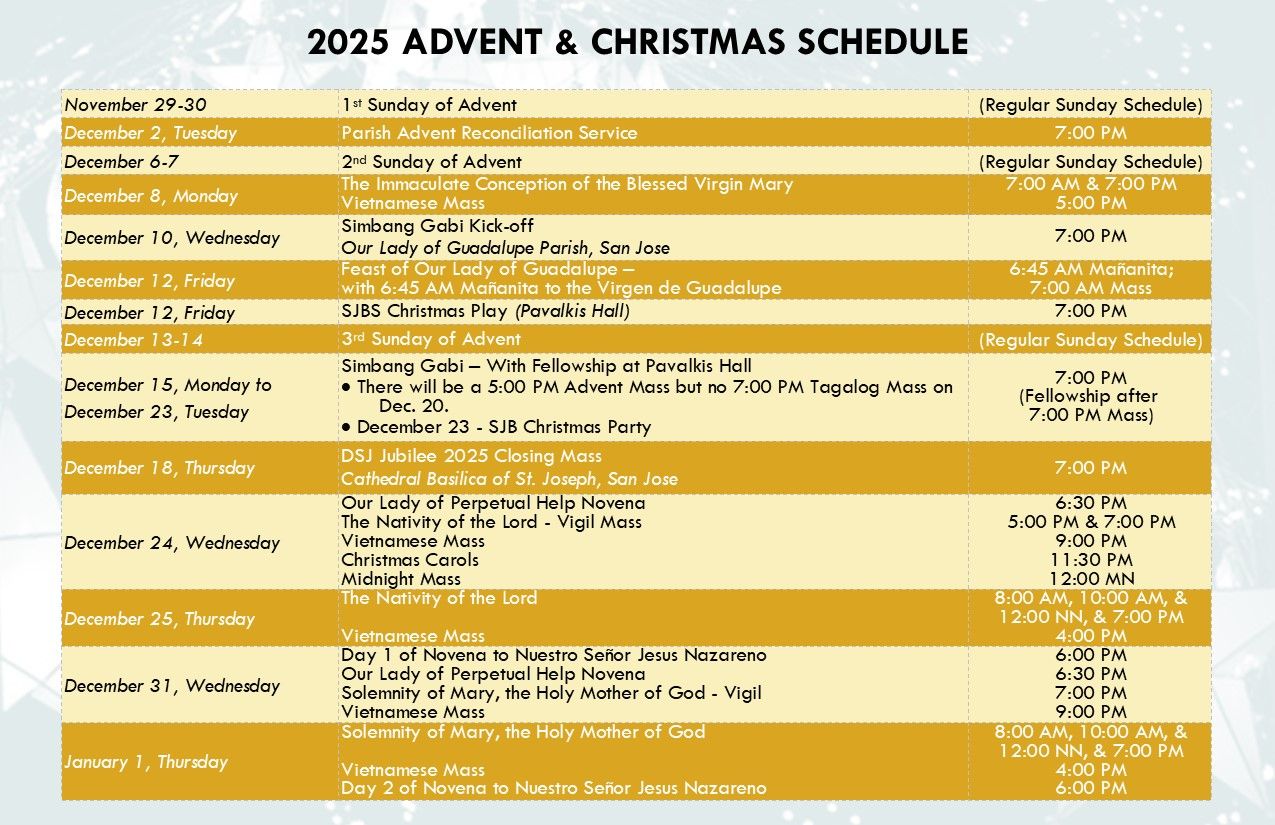
You can pick up a Simbang Gabi envelope from an usher. Inside, you will find the pastor’s letter and our 2025 Advent and Christmas Trifold, which lists the different liturgies and events of the season, including the presiders and sponsoring parish groups for each Simbang Gabi. Also enclosed is information and a paper form for submitting donations.
Donations may be made online or on paper. Donors’ names will be displayed on the overhead screens before/during the Mass. Submit your intentions no later than 9 pm the night before your requested date; intentions received on the requested date itself will be displayed the next day.
Origin
Know more about the Filipino Advent tradition honoring the Blessed Mother
Simbang Gabi (literally, “Mass at Night”), a 9-day novena of early morning Masses, begins at St. John the Baptist, on December 15 and ends on December 23.
Origin
The beginnings of Simbang Gabi can be traced back to 1668, when religious missionaries brought from Mexico the practice to the Philippines. There are a few versions of the story of its origin, but one of them is that the priests from the Spanish period agreed to hold the pre-dawn Masses so that farmers could hear Mass before they set off to work in the fields.
Traditionally, Simbang Gabi is celebrated in honor of the Blessed Virgin Mary. Pope Sixtus V, however, added the following intentions: (1) glorification and exaltation of the Holy Mother Church; (2) propagation of the Holy Catholic Faith; and (3) preservation of the newly baptized natives in the True Faith.
Today in the Philippines, Simbang Gabi is celebrated “for the perseverance of the Filipino nation in the faith and the preservation of our holy religion in this part of the world.” In the Diocese of San Jose and in other dioceses in the United States, it has become, first and foremost, a way for people of different races to offer God worship and praise. Second, it is a way to express and develop personal spirituality by preparing the heart for the coming (Advent) of Christ at Christmas. Third, it is a way to develop community through a common effort of prayer, work, celebration, fellowship, and charity. Some Masses in the Diocese are offered very early in the morning; most Masses are in the evening.
It is good to reflect on this intention at this time of challenges and disagreements. And as we attend the early morning or evening Masses, let us ask God to help heal our nation and bless the hearts of our leaders.
Simbang Gabi Then
Simbang Gabi was held before dawn so that farmers and fisherman would be able to participate in them before the usual early start of their labor for the day. In fact, the flickering candles in the star-shaped parols or Christmas lanterns that adorned the humble houses gave light to the early-morning churchgoers on their way to Simbang Gabi.
The pre-dawn Mass was announced by the ringing of the church bells. In some rural areas, an hour before the start of Simbang Gabi, a brass band played Christmas music all over the town. It is also believed that parish priests would go far knocking on doors to wake and gather the faithful to attend the Misa de Gallo. Farmers as well as fishermen woke up early to hear the Gospel before going to their work and ask for the grace of good harvest.
In Simbang Gabi, the Spanish missionaries took the opportunity to evangelize the people. The church bells reminded them of their faith and the bells indicated when the families pray the Angelus, the rosary and the children are blessed with the sign of the cross on the forehead. Simbang Gabi, for example, was introduced to teach the people the meaning of Christmas and how to prepare for the coming of the Messiah. At the same time, it was also used to catechize the people on the meaning of the Mass. Simbang Gabi, from the onset, was a catechizing and evangelizing moment, when rich and poor, men and women, children and elderly, came together as a community waiting for the coming of the Lord and rejoicing in the promise of the Messiah.
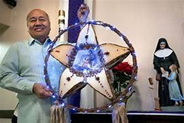
Simbang Gabi Now
The changing of times does not break the preservation of celebrating Simbang Gabi although it is celebrated in new ways. Still, the tradition of Simbang Gabi continues. Families, friends and even individuals find its way going to the nearest church to attend the nine-day novena. It soon became a cultural tradition during Christmas season where social festivities and “salu-salo” (fellowship) gained more prominence.